


There was a moment, around 2016 or so, when something shifted in how we allowed women to suffer in public. The girlboss era had exhausted itself—all that leaning in, all that shattering, all that corporate feminism that promised liberation through hustle. And in its place emerged a different figure: the woman who was simply (and sometimes spectacularly) failing. But there was a catch: she wasn’t learning from it… oh no. Forget the fuck about some normative version of growing through it. She was just sad. She was a sad girl, even if she was, by all accounts, a woman.
You know the canon even if you haven’t read the syllabus. Phoebe Bridgers singing about motion sickness and wanting to be embalmed. Fleabag breaking the fourth wall after doing something unforgivable. Sally Rooney’s heroines drifting through Dublin in a haze of text messages and borrowed flats. The Moshfegh narrator medicating herself into oblivion. Lana Del Rey—really the proto-sad-girl, the Tumblr patron saint—crooning about being someone’s kept woman in the Hollywood hills. Later: Billie Eilish, Mitski, Clairo. Hell, even Swift plays with the same boohoo-core. The aesthetic had its theme songs before it probably even had a name.
That these women weren’t role models was kind of the whole point. They offered permission to be broken without a redemption arc, to sit inside damage without metabolizing it into a TED Talk. After decades of empowerment rhetoric, here finally was an acknowledgment that sometimes you just fall apart and there’s nothing much aspirational about it.
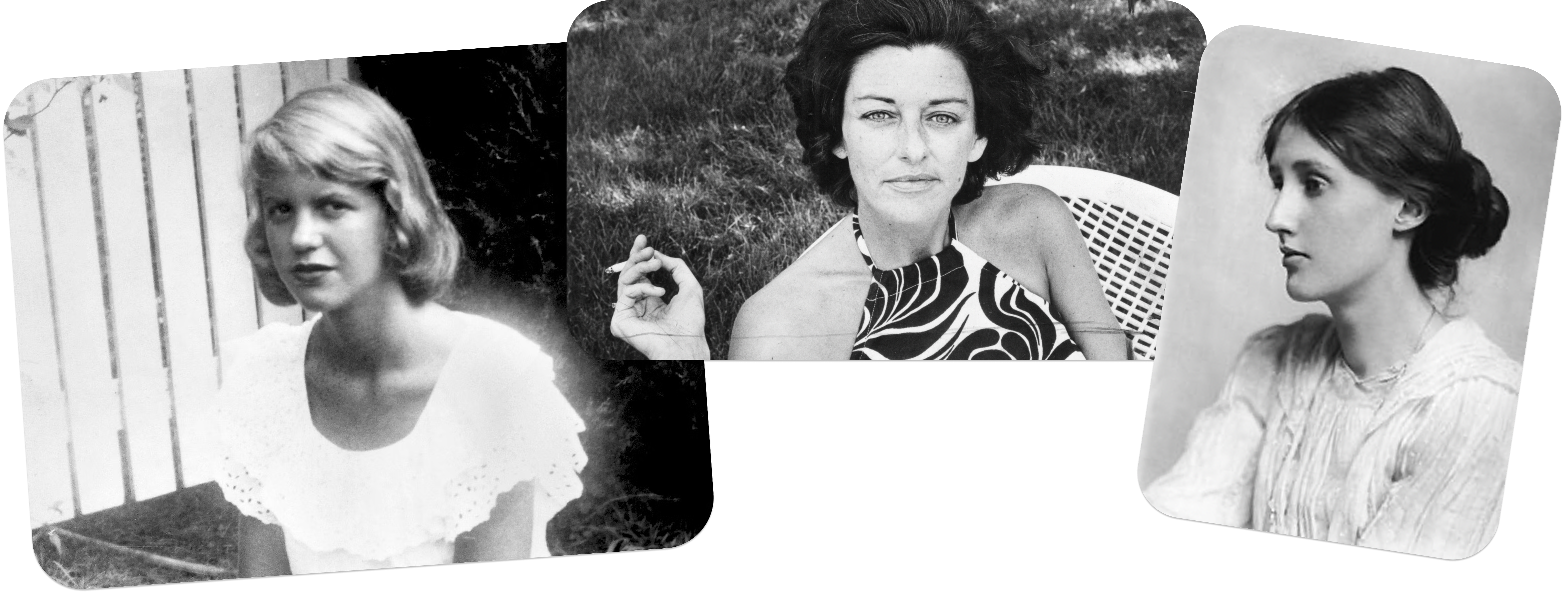
The sad girl lineage, of course, runs deep if you want to trace it. Sylvia Plath, obviously. Anne Sexton. (Virginia Woolf—though I feel she’d be turning in her watery grave being referred to as a “sad girl”.) The confessional poets who made female suffering into art before the second wave told them that was reactionary. All of this is to say: the sad girl has always been with us. What was new was the mainstreaming of her—the way she suddenly became a market category, a streaming genre, an algorithmically-enhanced vibe, yo.
But something’s curdled. You feel it, right?
The confession has become a costume. You can buy it at Target now—sad girl as aesthetic, dissociation as personal brand, depression as a kind of alt-lifestyle. This is what capitalism does to everything genuine, of course. The system has a genius for metabolizing its own critique—for finding the thing that feels like resistance and selling it back to us as product. And there’s something uniquely grim about watching female interiority disintegrate or rather glaze over in this way.
So what comes after all this?
I think of Han Kang’s The Vegetarian, where a woman’s maddening (from the perspective of those around her) refusal to eat meat becomes something cosmic, mythic—her suffering estranges rather than invites identification. Or Samantha Harvey's Orbital, where six astronauts circle Earth sixteen times in a single day and their interior lives dissolve into something luminous and planetary—consciousness unmoored from gravity, suffering rendered small and radiant against the blue curve of the world. In the realm of genre (and yet still often more literary than lit fic), there are writers like Silvia Moreno-Garcia whose latest The Bewitching navigates three different women in three different timelines—women whose power and choices ripple across decades.
Maybe that’s the turn. Away from just confession and toward story. Away from the self and toward the world?
The confessional mode has been the dominant literary register for women’s writing for decades now. What would it mean to write female interiority as mystery rather than confession? To let a woman be opaque, even to herself? To build a narrative that doesn’t resolve into self-knowledge but into something stranger—a house with no exit, a body becoming tree, a world that doesn’t care about your feelings and yet is beautiful anyway?
I don’t know. But I’m tired of wounds as content. I want literature that makes me look up from myself. That gives me a story with a spine, somewhere to go, a reason to keep turning pages that isn’t just the pleasure of recognition. The sad girl made us feel seen. Maybe the next thing makes us see. ¯\_(ツ)_/¯
I love this perspective so much as a writer and a reader. Thank you for naming this pattern!
Thank you for including Anne Sexton along with Plath and Woolf. I'm always curious about why Plath is iconic but Sexton is not. There's a good article there that I have never made time to pursue.